Bader Charge Analysis
Richard Bader’s Quantum Theory of Atoms in Molecules (QTAIM) separates regions of space into atoms using 2D surfaces of zero flux.
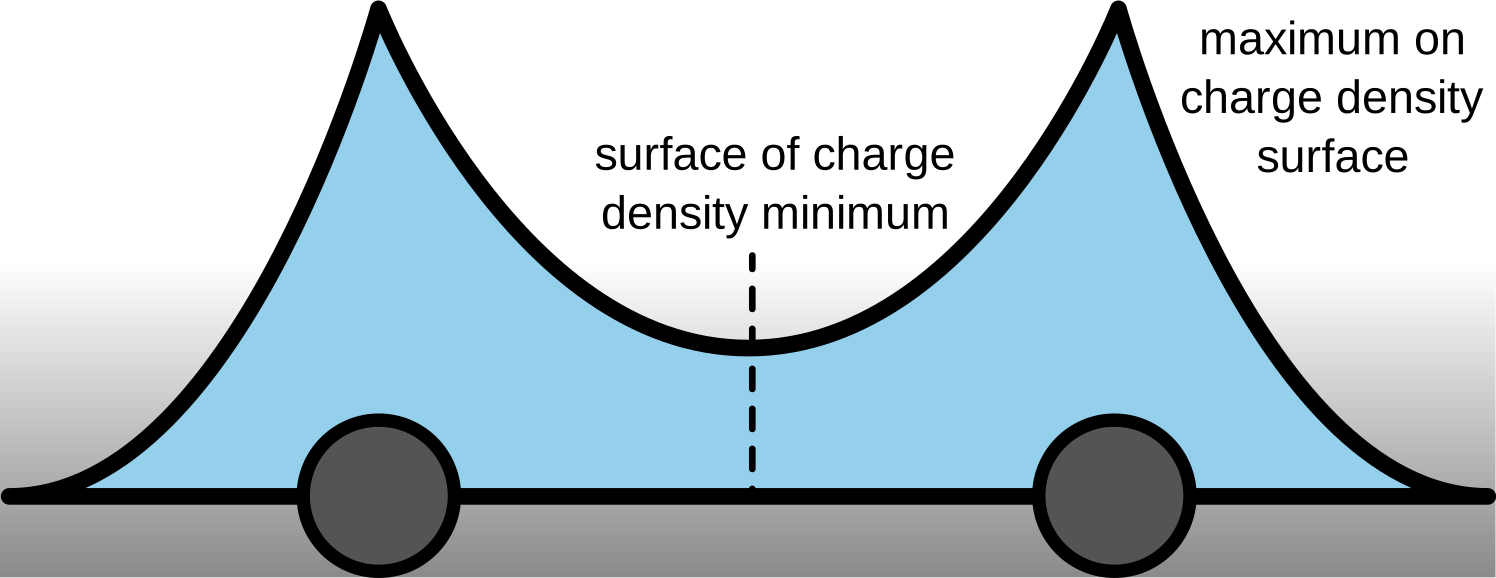
QTAIM can be used to identify Bader volumes in which charge density can be
attributed to an atom. The bader code developed by the Henkelman Group
([TSH09], [SKSH09], [HAJ06], [YT11]) can be used to perform Bader charge
analysis (BCA) using the output of a VASP or Gaussian calculation. Follow the
instructions for how to appropriately set up these calculations and generate
the ACF.dat file. For a VASP calculation, the following script is a good
starting point:
from ase.calculators.vasp import vasp
from ase.build import molecule

atoms = molecule('HOCl', vacuum=10, pbc=True, tags=[0, 1, 1])
calc = Vasp(
    algo="all",
    encut=450,
    gga='PE',
    gamma=False,
    isearch=1,
    ismear=0,
    ispin=2,
    ivdw=12,
    kpts=(1, 1, 1),
    kpar=4,
    laechg=True,
    prec='Accurate',
)
atoms.calc = calc
atoms.get_potential_energy()
ccu wraps functionality from ASE’s attach_charges() to
analyze BCA data from the ACF.dat file. The ccu pop bader-sum subcommand
can be used to calculate net atomic charges for user-defined moieties:
$ ccu pop bader-sum --atoms final.traj --sort-file ase-sort.dat 0 1
[0, 1]: ...
$ ccu pop bader-sum --atoms final.traj --smart-mode --sort-file ase-sort.dat
0: ...
1: ...
W. Tang, E. Sanville, and G. Henkelman A grid-based Bader analysis algorithm without lattice bias, J. Phys.: Condens. Matter 21, 084204 (2009).
E. Sanville, S. D. Kenny, R. Smith, and G. Henkelman An improved grid-based algorithm for Bader charge allocation, J. Comp. Chem. 28, 899-908 (2007).
G. Henkelman, A. Arnaldsson, and H. Jónsson, A fast and robust algorithm for Bader decomposition of charge density, Comput. Mater. Sci. 36, 354-360 (2006).
M. Yu and D. R. Trinkle, Accurate and efficient algorithm for Bader charge integration, J. Chem. Phys. 134, 064111 (2011).